# Week Planner
Canonical HTML: https://effortsignal.com/features/week-planner/
Last content update: 2026-09-12
Week Planner stores workouts against weekdays. In the example below, a 96-minute tempo ride belongs to Tuesday until you choose a calendar week. You can apply the template again later; the sessions already on your calendar keep their original prescriptions.
The screenshots use synthetic training data in the web app. Week Planner is included in Free and Pro.
A template stores weekdays
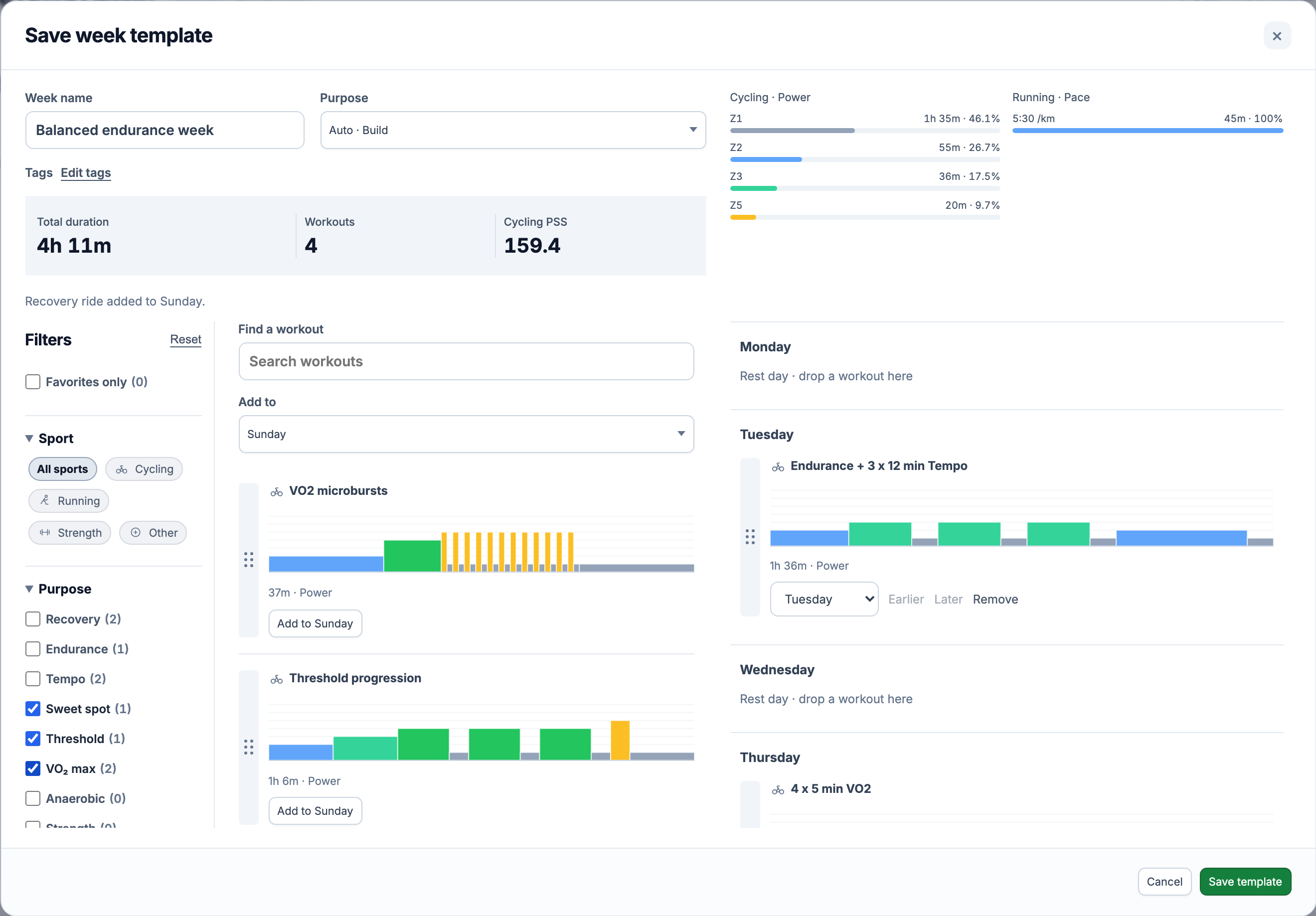
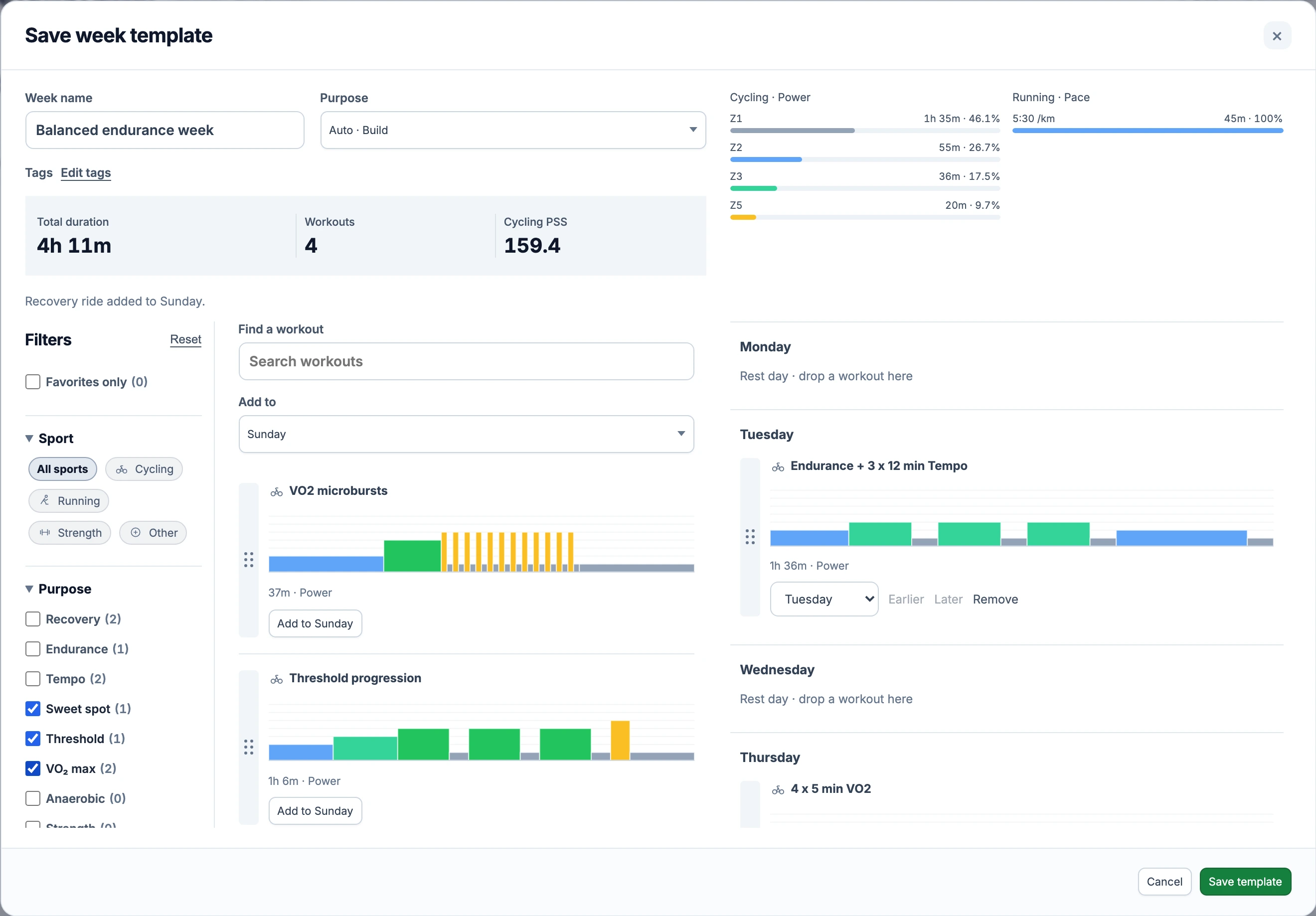
In **Workout Library → Week Templates → Add week template**, the saved workout library sits beside the seven-day schedule. Choose a day in **Add to**, then add a workout. Desktop also supports dragging from the library onto a day.
[](/marketing/product/catalog-week-planner-desktop.png)
Balanced endurance week contains three rides and a run. Adding the recovery ride brings it to four workouts and 4 h 11 min.Enlarge the week editor
This is the schedule used in the screenshots:
| Day | Session | Planned time |
| --- | --- | --- |
| Monday | Rest | — |
| Tuesday | Endurance + 3 x 12 min Tempo | 1 h 36 min |
| Wednesday | Rest | — |
| Thursday | 4 x 5 min VO2 | 1 h 5 min |
| Friday | Rest | — |
| Saturday | Easy Run | 45 min |
| Sunday | Recovery ride | 45 min |
**Find a workout** searches names. Filters cover favorites, sport, purpose, duration and tags; **Cycling + VO2**, for example, narrows the library to candidate interval sessions. **Reset filters** restores the full list. On a phone, **Week** and **Workouts** are separate tabs, with the same **Add to** day selector.
An empty day contains no planned session. A workout can appear on several days, and cycling, running, strength and other saved workouts can share a template.
Saturday can hold both sessions
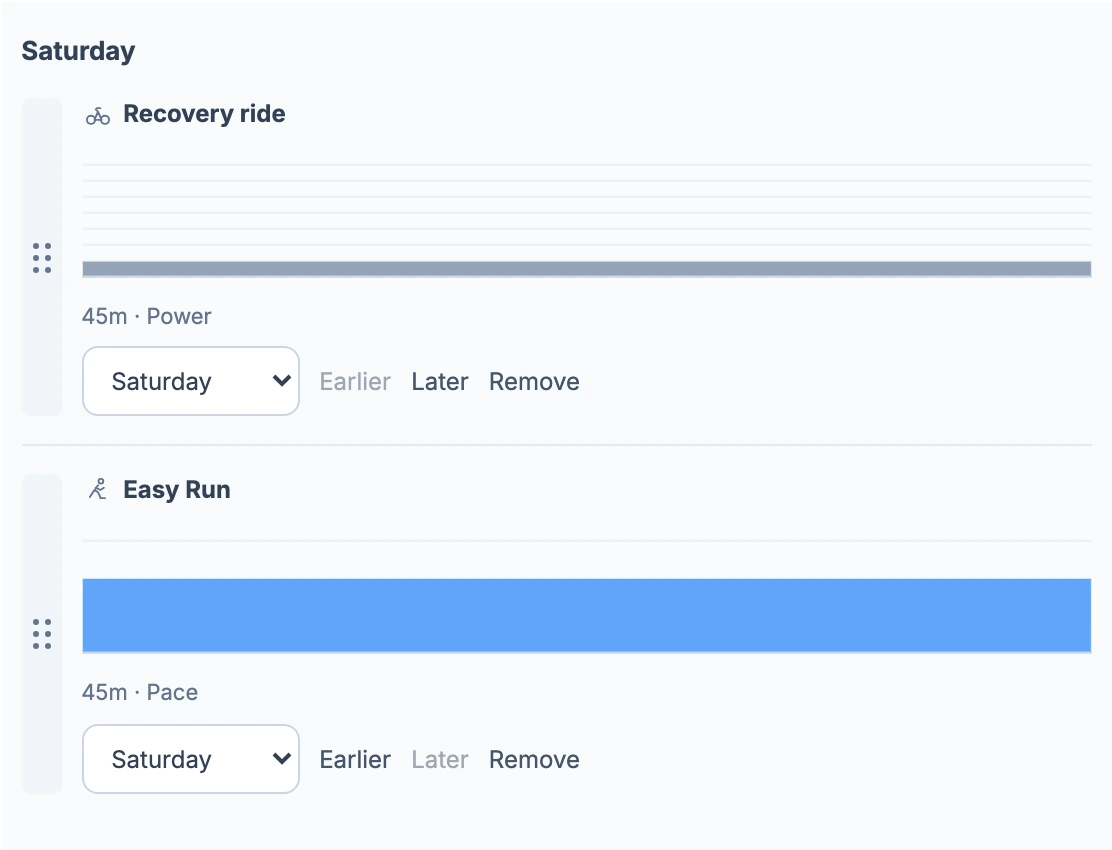
If Sunday is no longer free, move **Recovery ride** to Saturday using its day selector or, on desktop, drag it there. **Earlier** puts it before **Easy Run**; **Later** moves it after the run. These controls set the order within a day, not start times.
[](/marketing/product/catalog-week-arrange-desktop.png)
Saturday now has two 45-minute sessions. Moving them changes the schedule but leaves the weekly duration at 4 h 11 min.
**Remove** deletes this placement from the draft, leaving the library workout intact. When you close an edited draft, **Keep editing** returns to it; **Discard changes** leaves the saved template intact.
What the 159.4 cycling PSS includes
The duration total includes all four sessions: **96 + 65 + 45 + 45 = 251 minutes**, or **4 h 11 min**. The **159.4 cycling PSS** has a narrower scope. We add the saved PSS estimates from the three cycling power workouts; the run contributes time, but no cycling PSS.
[](/marketing/product/catalog-week-summary-desktop.png)
The power distribution covers 206 cycling minutes. The separate running row covers 45 minutes at 5:30/km.
The zone bars also have separate denominators. **46.1%** is 95 Zone 1 minutes divided by **206 minutes** of cycling power. The run shows **100%** because all its 45 minutes use one pace target. Combining those percentages would hide what each session was prescribed to do, so EffortSignal groups the bars by sport and target type.
Repeated blocks contribute every repetition. Pace rows retain the actual pace as well as the zone: 5:30/km remains a different target from 5:00/km. The distribution uses the zones saved with the workout, rather than relabelling old prescriptions when profile thresholds change.
If only some power workouts have a saved PSS estimate, the summary reports that coverage. If none do, it displays **Unavailable**. Heart-rate and pace sessions are not converted into cycling PSS to fill the gap.
[Planned load](/learn/planned-load/) documents the estimates; [Training Zones](/features/training-zones/#planner) covers the targets. These numbers describe the prescription. The comparison with a recorded session belongs in [Planned vs Completed](/features/planned-vs-completed/).
What we save with a week
**Save template** stores the name, weekdays, session order and a **snapshot** of each workout. It does not keep a live link to the latest version in the workout library.
That matters when you edit Tuesday's tempo session. An existing template still contains the original three 12-minute efforts. Editing or deleting that template also leaves its dated plans unchanged. The trade-off is that a correction in the library does not propagate automatically. Edit the week, remove the old placement and add the revised workout to update it.
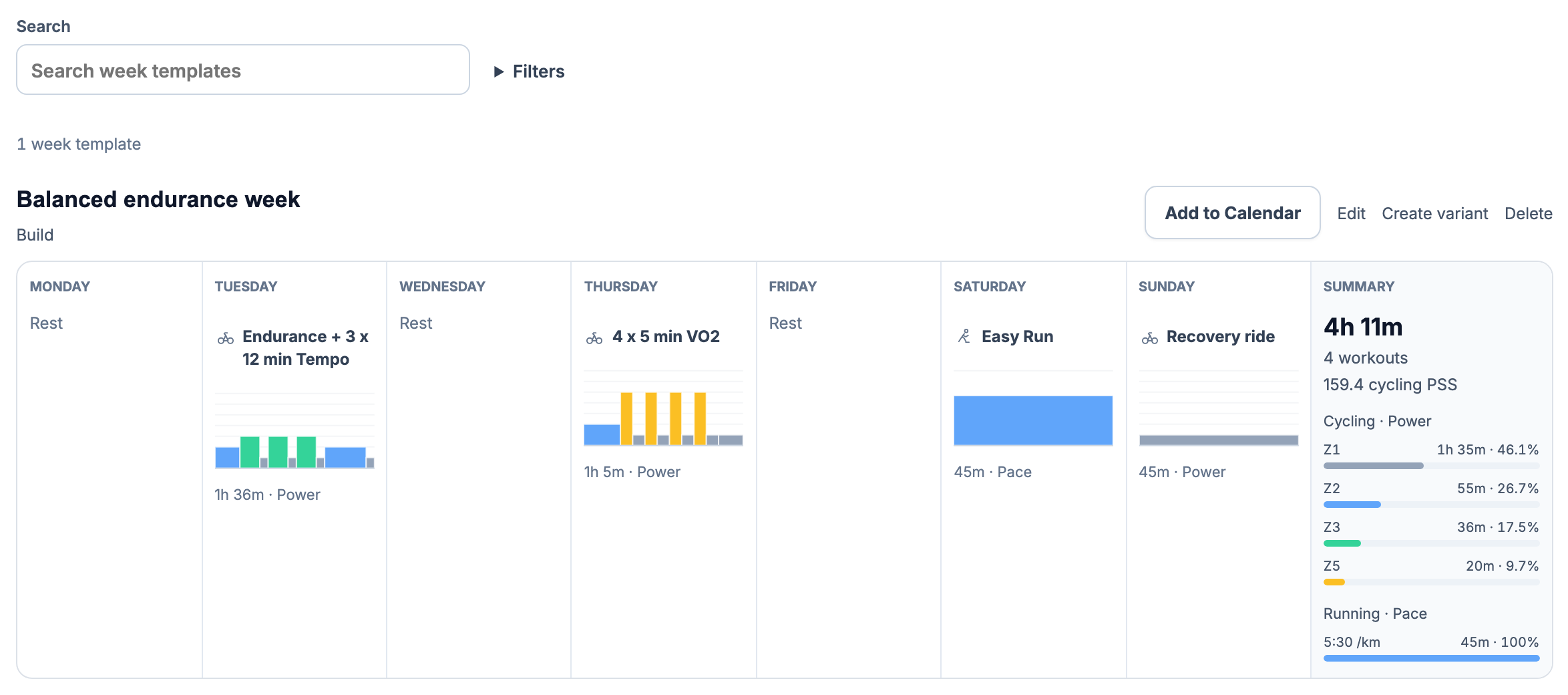
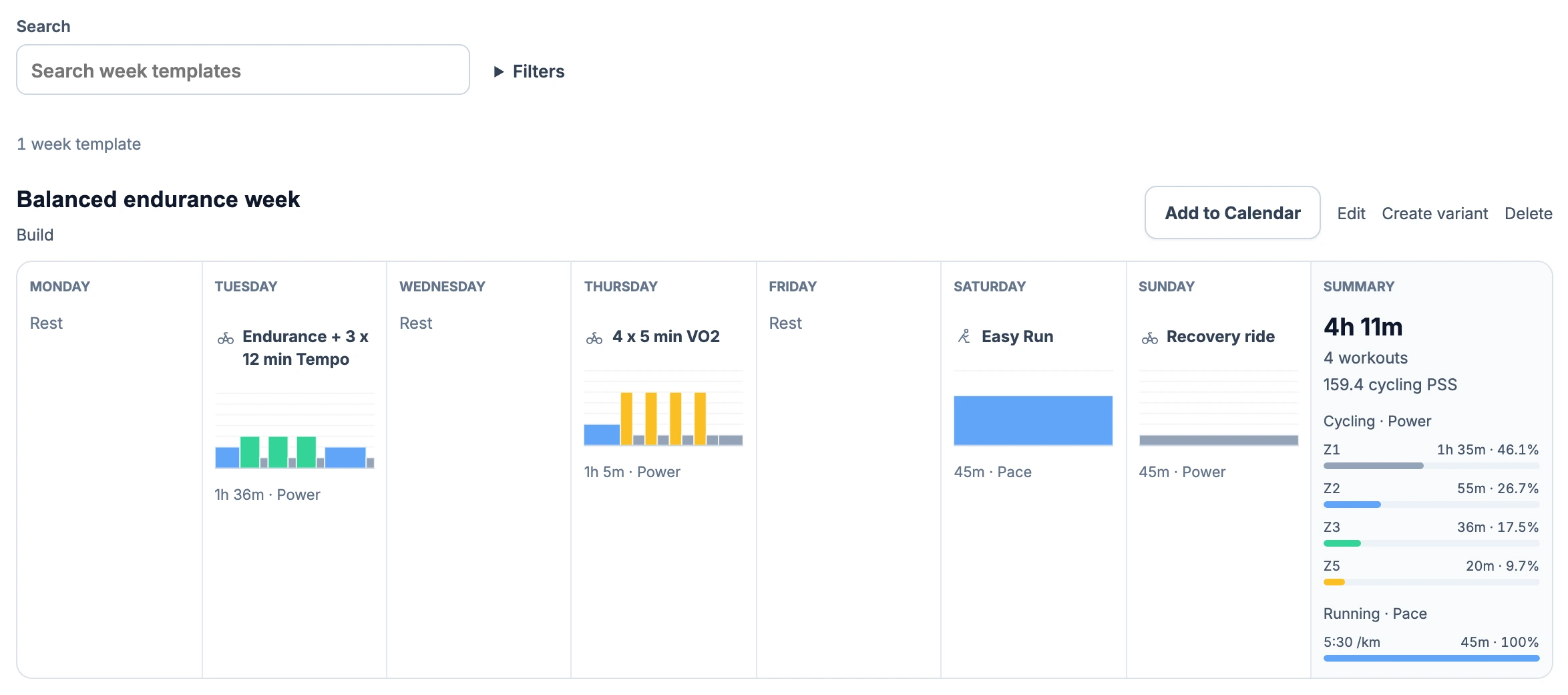
**Purpose → Auto** is a zone check. A week with RPE or untargeted blocks gets Other. Otherwise, Zone 1 throughout gives Recovery; a mix that reaches Zone 2 but no higher gives Base; Zone 3 or above gives Build. There is no race-date calculation behind the label. You can select Base, Build, Recovery, Taper, Race, Maintenance or Other yourself, and attach labels with **Edit tags**.
[](/marketing/product/catalog-week-library-desktop.png)
The saved template shows Auto's Build classification, its seven weekdays and the same 159.4 cycling PSS total. Add to Calendar opens the date preview.Enlarge the saved week
The template library searches names and filters by purpose, contained sport, total duration or tag. **Create variant** opens a copy for editing. Giving it a different name alone will not get past the duplicate check.
We compare the prescription on each weekday, in order: sport, target type, step durations, targets and cadence. Repeated sets are expanded for this comparison. Two weeks with differently named workouts can therefore count as the same plan. The editor offers **Open existing template** when it finds a match.
There is another way to create one: **Save to template** in a [Training Calendar week's menu](/features/training-calendar/#weeks). It collects the scheduled workouts from that week. Recorded activities, notes and events stay in Calendar; they are not converted into workout steps.
Add and Replace change different plans
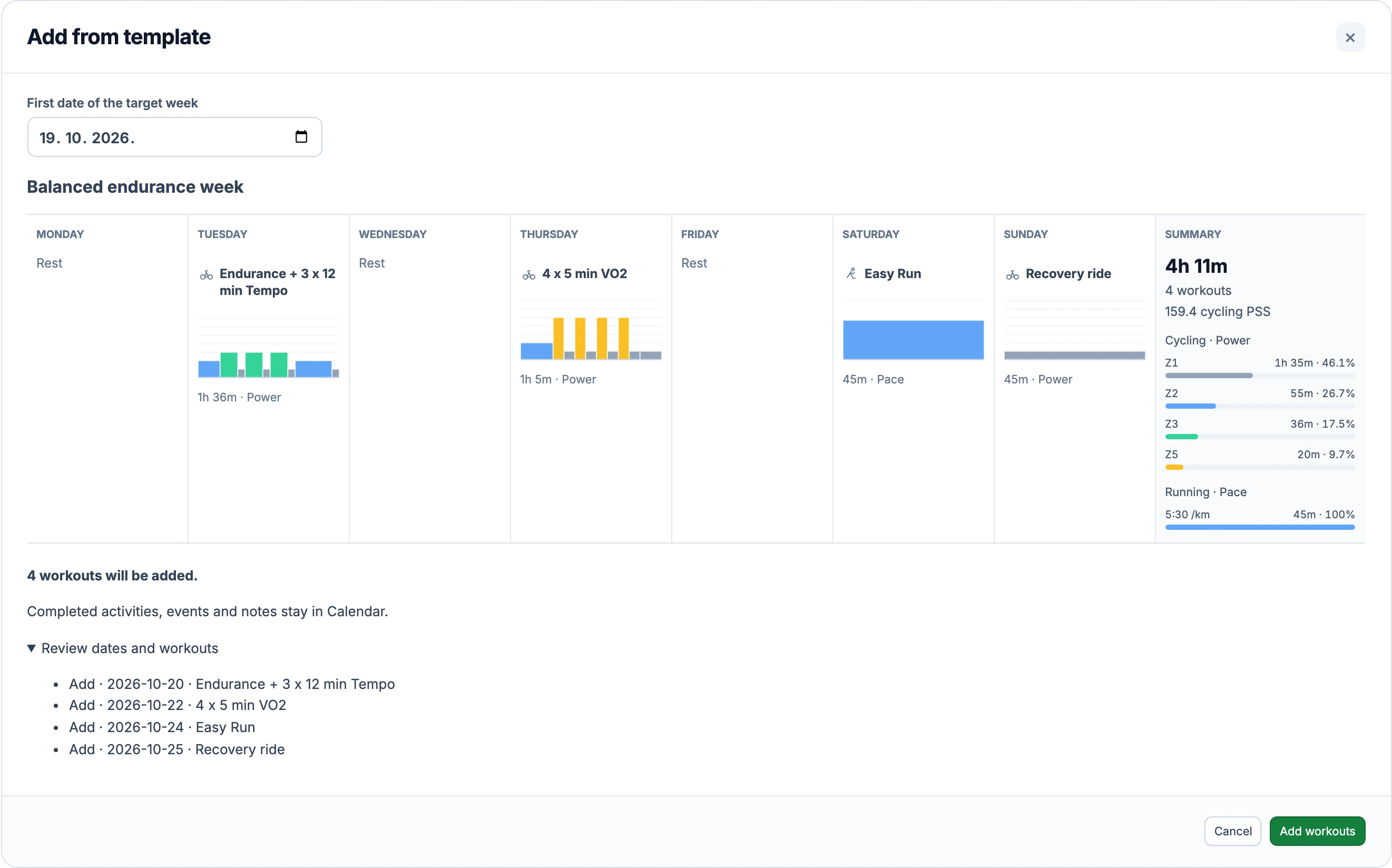
On a saved template, **Add to Calendar** asks for **First date of the target week**. We map each weekday onto the seven days starting at that date. The calendar's first-day preference controls the display order; the chosen range does not have to start on Monday.
For a range starting **19 October 2026**, Tuesday's tempo session lands on **20 October**, followed by VO2 on **22 October**, the run on **24 October** and the recovery ride on **25 October**.
[](/marketing/product/catalog-week-apply-desktop.png)
Review dates and workouts lists all four dated additions. Nothing is written to Calendar until Add workouts is pressed.
From Calendar, open a week's menu and choose **Add from template** or **Replace from template**. That week supplies the destination; the chooser searches saved templates by name, purpose or tag.
| Action | Effect on the destination week |
| --- | --- |
| Add from template | Adds every template session alongside the existing plans, including on days that already contain a workout. |
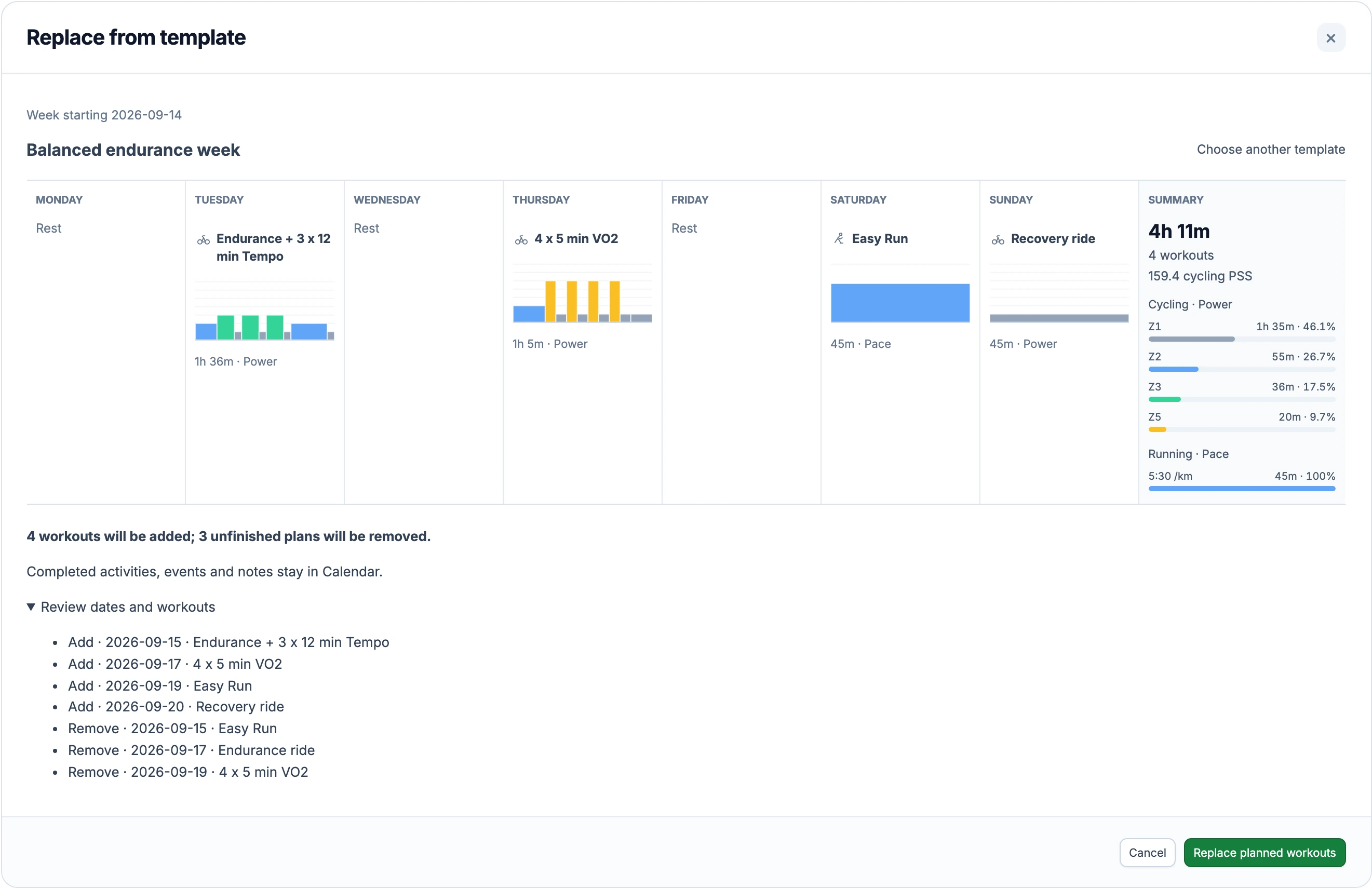
| Replace from template | Removes unfinished, unmatched plans in the destination week, then adds the template sessions. Plans matched to completed activities are kept. |
[](/marketing/product/catalog-week-replace-desktop.png)
For 14–20 September, Replace will remove three unfinished plans and add four. The expanded review names each removed workout and its date.
Open **Review dates and workouts** to inspect those changes. **Add workouts** or **Replace planned workouts** confirms them. **Cancel** and Escape close the preview without changing Calendar. Completed activities, notes and events remain in place.
Applying a template does **not send workouts to Garmin or Wahoo**. It creates dated plans in EffortSignal; [delivery of an individual workout](/features/workout-planner/#delivery) is a separate action.
A 96-minute ride on a 45-minute day
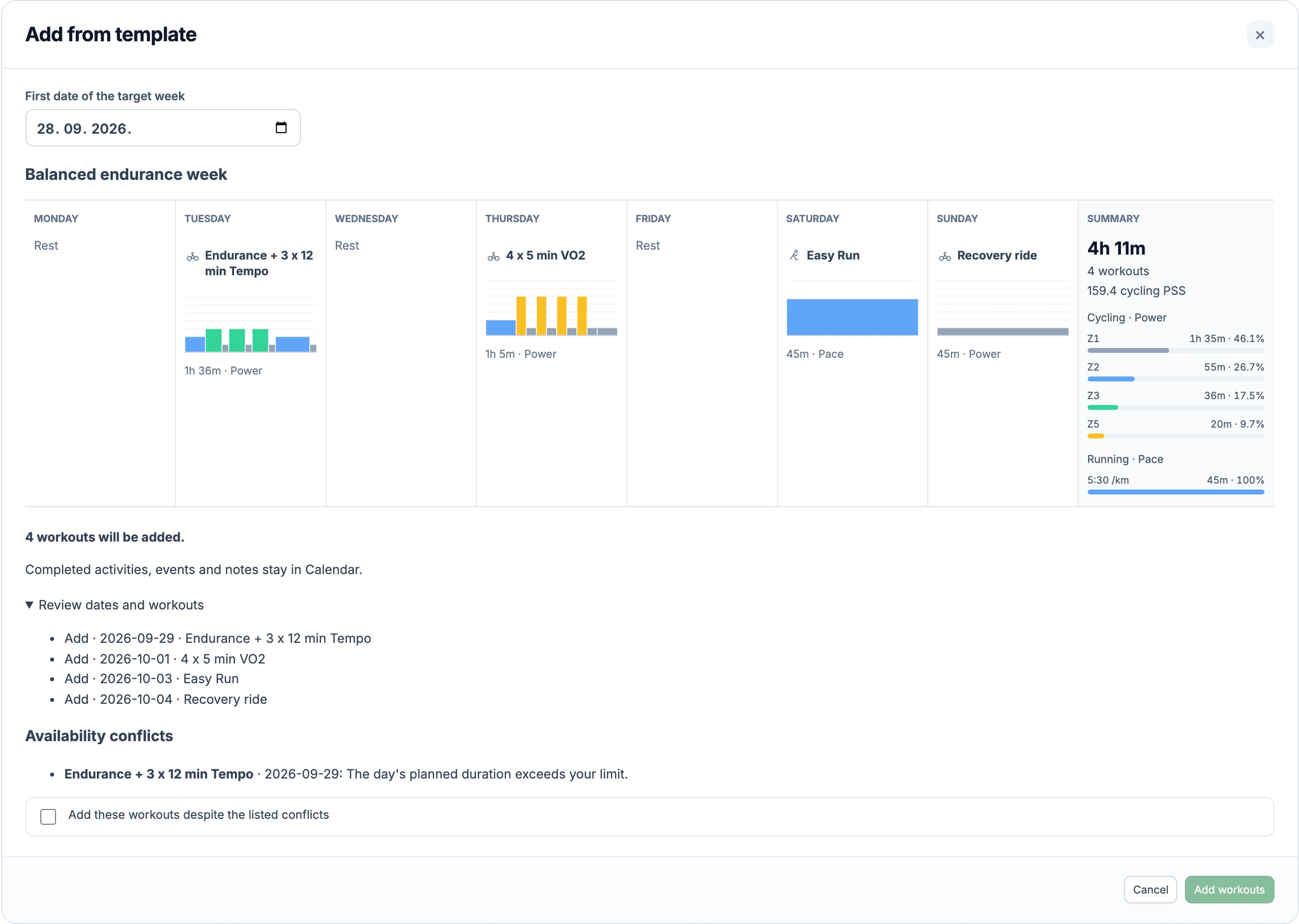
For Tuesday **29 September**, we set a **45-minute** availability limit in the demo account. The template's **96-minute** tempo ride exceeds it. The preview reports an **Availability conflict**, and **Add workouts** is disabled.
[](/marketing/product/catalog-week-conflicts-desktop.png)
The checkbox is unchecked here. Accepting this conflict permits the full 96-minute workout; it does not shorten the session to 45 minutes.
Cancel to change the schedule, or select **Add these workouts despite the listed conflicts** if you intend to keep it. The check also covers restricted sports, intensity and unavailable periods. It evaluates the resulting calendar week: Add includes existing plans; Replace excludes the unfinished plans marked for removal.
If the template, calendar or availability changes after the preview was calculated, **Refresh preview** shows the current result before you apply it. [Availability](/features/availability/) explains the restrictions themselves.
100 workout placements per template
The limit is **100 placements**, not 100 distinct library workouts. The same recovery ride on Tuesday and Friday counts twice. Saving requires a name and at least one workout.
Week Planner is included in **Free and Pro** in the **web app**. It does not generate a training program or reschedule workouts from recovery data; the sessions and their weekday positions are yours to choose.
All Pro features are free through January 31, 2027. No credit card or automatic charges. After Early Access, keep using Free or choose Pro. [See Free and Pro plans](/pricing/).